


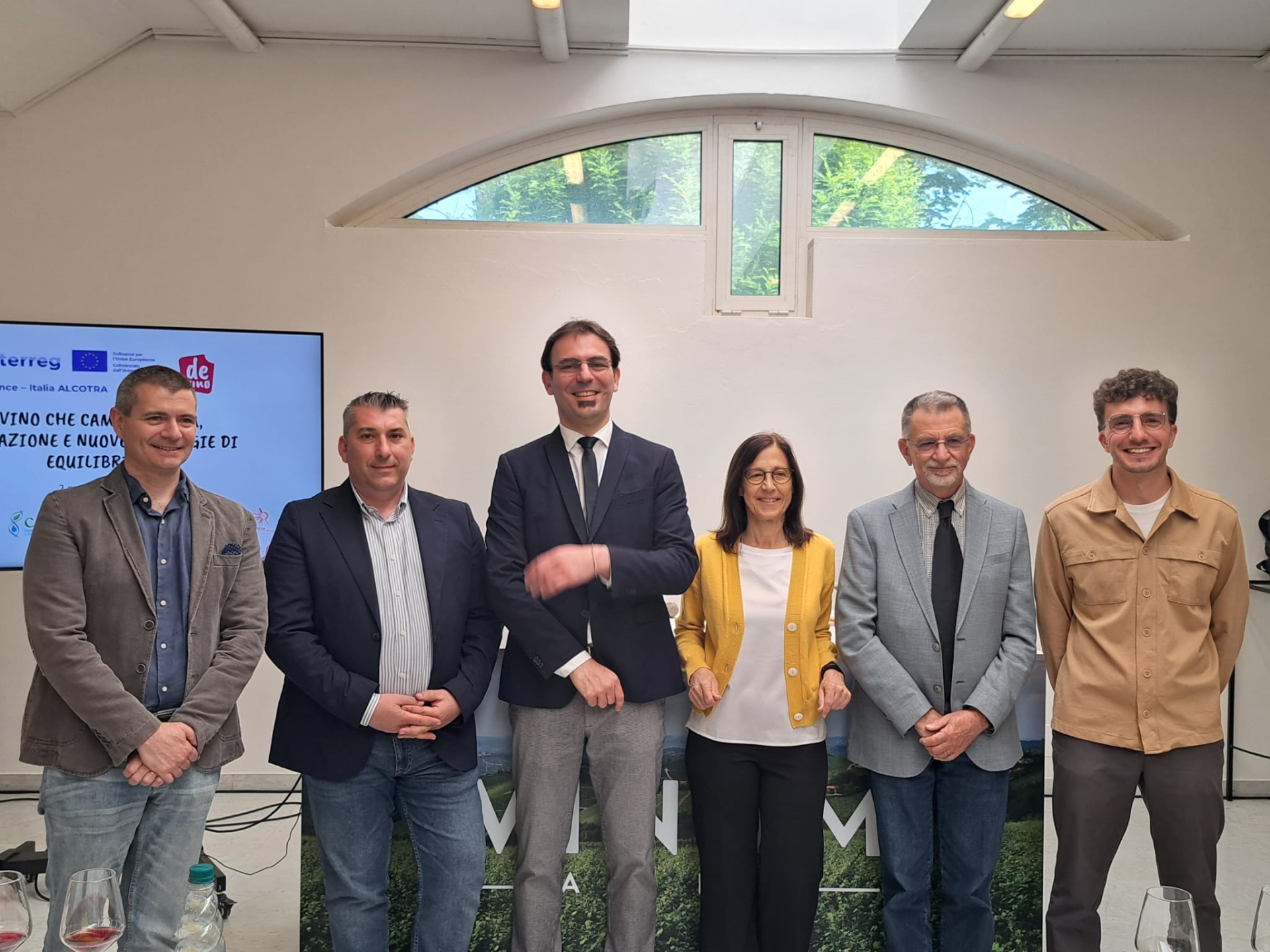
Alba, 2 May 2026 – The event “Wine in Transition: Climate, Ripening and New Strategies for achieving Balance” took place in Alba as part of the Vinum 2026 programme, within the framework of the cross-border project DEVIN0.
DEVIN0 is a project funded by the Interreg VI-A France–Italy ALCOTRA Programme, with Apro Formazione acting as lead partner, in partnership with the Council for Agricultural Research and Economics (CREA), Vignaioli Piemontesi SCA and the Centre de Recherche et d’Expérimentation sur le Vin Rosé in Provence.
The initiative comes at a time of profound transformation in the wine sector, largely influenced by the effects of climate change. Rising temperatures recorded in recent years have accelerated grape ripening, resulting in an increase in the sugar concentration and alcohol content of wines.
At the same time, the market is showing growing interest in lower-alcohol products, particularly among younger and female consumers, representing a market segment that continues to expand.
The proceedings were opened by Roberto Cavallo, Councillor for Agriculture, Productive Activities and Ecological Transition of the Municipality of Alba, and by Stefano Mosca, Director of the Alba International White Truffle Fair.
During the workshop, experts and researchers outlined scientific and technical approaches aimed at adapting viticulture and oenology to the new climatic conditions. In particular, Silvia Guidoni and Vincenzo Gerbi from the Department of Agricultural, Forestry and Food Sciences (DISAFA) at the University of Turin explored the main challenges linked to changes in vine phenology and the resulting implications for viticultural and oenological practices.
The “Clima e Vite” platform was also presented during the workshop – a research project funded by the Turin Chamber of Commerce, developed as a decision-support tool for winegrowers in managing the new climatic conditions.
Particular attention was paid to winemaking techniques, particularly the management of acidity, colour and the sensory profile of wines. It was also highlighted that changing climatic conditions require winemakers to rethink how they assess grapes upon arrival at the winery.
Federico Piano (CREA – Asti) then focused on alcohol reduction, presenting the main technologies currently available for the partial and total dealcoholisation of wine. Davide Viglino, Director of Vignaioli Piemontesi, outlined the evolution of the regulatory framework governing these oenological practices.
At the end of the conference, a blind comparative tasting of three wines (Vermentino, Cortese and Barbera) took place, presented in their original form and in two versions with different levels of alcohol reduction. The tasting offered valuable insights for both researchers and market operators, while enabling a direct comparison of the wines’ sensory and qualitative profiles. Interestingly, the highest ratings were given to the original wines and to the versions with the greatest reduction in alcohol content.
For further information on the project: https://devino-project.eu